A strange thing happens to a lot of language learners. They understand much more than they can comfortably say.
Reading feels manageable. Listening sometimes feels manageable too, at least until somebody starts talking quickly or casually. But speaking creates a completely different reaction. People suddenly slow down, overthink simple phrases, apologize for mistakes before even finishing the sentence, or switch back to their native language the moment conversations become unpredictable.
That frustration has quietly changed what learners expect from language apps.
For a long time, most platforms trained people to become very good at exercises. Users memorized vocabulary, filled gaps in sentences, matched words with translations, and repeated grammar patterns over and over again. Those systems helped with recognition. They did not always help people feel relaxed during actual conversations.
Now, learners are paying attention to something else. Not perfect grammar. Not streak counts. Not lesson totals. Speaking confidence.
A growing number of users want platforms that push them into active communication much earlier. They want pronunciation practice, conversation repetition, realistic dialogue, listening exposure, and situations where language feels alive instead of trapped inside drills.
That shift explains why speaking-focused platforms suddenly feel much more relevant than another stack of flashcards.
1. Promova
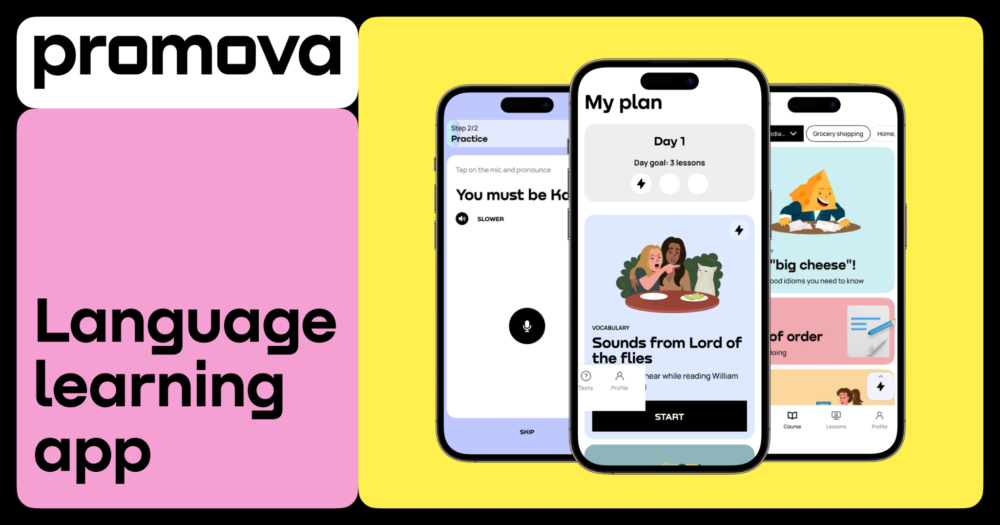
Promova is a language learning app for people who want to speak that combines structured self-study with AI speaking practice and conversation-based exercises designed to make learners use language actively instead of only reviewing it.
The platform feels very different from apps built mostly around passive repetition because speaking appears constantly throughout the learning process. Learners interact with AI conversations, pronunciation tasks, role-play exercises, and shadowing lessons instead of spending most of their time silently tapping through translations.
The platform includes:
- AI tutor interactions
- AI role-play conversations
- Speaking-focused exercises
- Pronunciation support
- Shadowing lessons
- Public speaking content
One thing Promova understands well is that many learners already recognize huge amounts of English passively. They watch movies, scroll through social media, consume YouTube content, follow creators online, and hear English at work almost daily.
The problem usually starts when they need to answer themselves naturally. That is where conversation-focused practice becomes useful. The platform keeps encouraging learners to respond, repeat, react, and speak out loud instead of treating conversation like something reserved for advanced users only.
Promova also approaches accessibility more seriously than many competitors.
A surprising number of educational apps still overload users with dense text blocks, chaotic layouts, constant visual stimulation, or interfaces that become exhausting during longer study sessions. Promova introduced features specifically designed for learners with ADHD and dyslexia, including:
- Dyslexia Mode 2.0
- White Noise Mode for ADHD learners
- Flexible lesson pacing
- Cleaner reading layouts
That creates a learning environment that feels calmer and easier to stay in.
Another detail that makes the platform stand out is the variety of lesson types outside standard beginner language courses. Users can explore:
- English for Public Speaking
- Neurodiversity in the Workplace
- American Sign Language (ASL)
- English-to-English lessons
- Shadowing-based speaking exercises
Promova currently supports English, Spanish, French, German, Italian, Korean, Japanese, Chinese, Portuguese, Arabic, and Ukrainian.
For learners who want speaking to become a normal part of studying instead of something they avoid for months, the platform feels especially practical.
2. Cambly
Cambly removes one thing many language learners secretly dislike about traditional apps.
Too much silence.
A lot of platforms keep users inside independent exercises for long stretches before actual conversation enters the process regularly. Cambly works almost the opposite way by centering the experience around direct speaking practice with tutors.
People commonly use the platform for:
- Everyday conversation practice
- Business English
- Pronunciation improvement
- Speaking confidence
- Interview preparation
- Travel communication
That constant interaction changes how learners react to mistakes.
Inside grammar exercises, errors often feel highly visible because there is usually one exact answer expected by the system. Real conversation does not work like that. People pause, search for words, restart sentences, interrupt themselves, and still communicate successfully.
Cambly exposes learners to that reality much earlier. One reason the platform feels comfortable for many users is the atmosphere during sessions. Conversations tend to feel informal rather than heavily structured. Learners can speak casually without feeling like every sentence is being graded.
That becomes especially important for people who already know a decent amount of English but panic once conversations stop feeling controlled.
The platform also gives learners flexibility in the type of speaking practice they want. Some focus on workplace communication. Others care more about casual fluency, pronunciation, or travel confidence.
3. Babbel
Babbel approaches language learning with a much stronger focus on practical communication than many heavily gamified apps.
The lessons revolve around situations people actually expect to encounter. Ordering food, introducing yourself, participating in conversations at work, traveling, asking questions, and understanding responses. The language feels connected to everyday interaction instead of abstract exercises designed mainly for repetition.
The platform includes:
- Interactive dialogues
- Speaking repetition
- Pronunciation feedback
- Listening exercises
- Context-based vocabulary practice
A lot of learners appreciate that Babbel feels relatively grounded.
The app does not constantly chase attention through aggressive notifications or fast-paced reward systems. Lessons stay fairly focused on communication itself, which makes studying feel calmer and more deliberate.
Another strength is how pronunciation and listening work appear naturally throughout the lessons. Users repeat complete phrases constantly instead of only memorizing isolated vocabulary items. That helps speaking feel more connected to conversational rhythm rather than individual word recognition.
For adult learners especially, that practical structure often feels easier to stay engaged with.
4. Busuu
Busuu combines structured self-study with feedback from native speakers, giving the platform a more human feel than many fully automated language apps.
One useful feature is the correction system. Learners can complete speaking or writing exercises and receive feedback from native speakers directly. That interaction exposes users to more realistic communication patterns outside perfectly controlled app exercises.
The platform offers:
- Speaking exercises
- Dialogue activities
- Pronunciation practice
- Grammar review
- Vocabulary lessons
- Community corrections
That community element changes how learners think about mistakes.
Inside isolated exercises, people often become obsessed with perfect accuracy because apps expect exact answers. Real communication usually feels much more flexible. Native speakers understand imperfect phrasing constantly.
Busuu introduces learners to that reality earlier. The platform also stays relatively organized without becoming overly rigid. Lessons follow a clear structure, which helps users avoid feeling scattered between unrelated activities while still keeping communication practice present throughout the experience.
For learners who want self-study with occasional human feedback, Busuu creates a comfortable middle ground.
5. Rosetta Stone

Rosetta Stone still follows a more immersion-based learning approach than most modern language apps.
Instead of relying heavily on translation exercises, the platform encourages learners to connect language directly with visuals, audio, repetition, and context-based scenarios.
The platform includes:
- Pronunciation analysis
- Interactive speaking exercises
- Listening repetition
- Immersion-style lessons
- Scenario-based learning
Some learners find the pace slower than modern mobile-first apps. Others specifically prefer that because it encourages direct comprehension instead of constant mental translation.
Rosetta Stone also feels noticeably quieter than many competitors. There are fewer distractions, fewer reward systems, and less visual stimulation competing for attention. For learners who dislike chaotic interfaces or highly gamified environments, that simplicity becomes one of the platform’s biggest advantages.
The pronunciation tools also remain one of its strongest areas. Users spend significant time listening carefully, repeating phrases, and becoming comfortable with natural sentence rhythm instead of focusing mostly on written exercises.
That repetition gradually builds speaking comfort in a more organic way.
Speaking anxiety is often a bigger problem than grammar
A lot of learners assume they need more vocabulary before conversations become easier. Very often, the bigger issue is hesitation. People become afraid of pauses. They worry about pronunciation. They mentally edit sentences before speaking and end up freezing because they are trying too hard to sound correct.
That pressure grows quickly once conversations feel unpredictable. Platforms focused on speaking confidence try to interrupt that pattern much earlier. Instead of treating conversation like something users attempt only after reaching advanced levels, they normalize imperfect speaking immediately.
And honestly, that changes motivation completely.
The moment learners realize communication still works without perfect grammar, speaking starts feeling much less intimidating.
Real communication is not clean or perfectly structured
Traditional exercises usually present language in an extremely controlled way. One question. One expected answer. One predictable sentence structure. Real conversations are messy. People interrupt each other. Sentences stay unfinished. Pronunciation changes depending on mood, speed, or accent. Some conversations barely follow textbook grammar at all.
That is why many learners eventually become frustrated with repetition-heavy apps. They realize they practiced exercises far more than communication itself.
Speaking-focused platforms feel different because they expose users to unpredictability much earlier. Learners respond, repeat, adjust, improvise, and hear language functioning inside more realistic situations instead of isolated drills.
The process feels less polished. It also feels far closer to actual conversation.
More learners want language practice that feels alive
One noticeable shift happening across language learning platforms is that people no longer want purely passive studying.
Completing exercises does not feel satisfying if conversations still create panic afterward. Learners want to hear themselves speak regularly. They want to respond faster without translating every sentence mentally. They want pronunciation to feel automatic instead of stressful.
That demand is changing the way platforms approach language learning.
The strongest apps are no longer built only around memorization systems. They are creating environments where speaking becomes part of everyday study instead of something learners postpone indefinitely.
For many users, that shift finally makes language learning feel connected to real life instead of another digital routine.