A manufacturing plant cannot pause its assembly line for a software update. A bank cannot freeze transactions while migrating customer data. A hospital cannot shut down patient records for system maintenance.
Yet legacy systems need replacement. The old code is brittle. The hardware is failing. Security patches stopped coming years ago.
The solution is product engineering services that work around live operations. The firms listed here have moved mainframe data to cloud platforms, rewritten decades old code, and replaced core systems while users kept working. Here is how they do it as a product engineering company.
What Zero Downtime Migration Means for Product Engineering
Regular software projects get maintenance windows. Teams announce downtime, shut down systems, perform work, and restart. Users wait.
Zero downtime migration does not work that way. Product engineering services for live systems require parallel runs, data synchronization, and cutover strategies measured in seconds.
A product engineering company handling this work must build temporary bridges between old and new systems. They run both side by side. Data flows into both simultaneously. When the new system proves stable, traffic switches over. Users never notice.
The four firms below have executed these strategies for enterprises that cannot afford a single second of interruption.
1. Avenga
Avenga is the best product engineering company for financial institutions moving off legacy core systems. Their product engineering services include parallel run strategies and zero-downtime cutover for banking platforms.
Zero Downtime Product Engineering Track Record
Marginalen Bank in Sweden needed to replace their old core banking system. The bank could not freeze accounts or stop payment processing during migration. Any downtime would affect customers and regulators.
Avenga engineered a phased product engineering migration to Mambu’s cloud platform. The team completed the transition in 13 months. They handled decommissioning of the old core, full data migration, and integration across the bank’s ecosystem, including data warehousing, microservices, and third-party providers. The transition had zero downtime.
Standalone features for zero-downtime product engineering:
- Phased cutover strategy with parallel system operation
- Data synchronization between legacy and cloud platforms
- Real-time validation before traffic switching
- Rollback procedures if issues appear during cutover
Primary strength: Core banking and financial system migration without transaction interruption.
2. Intellias
Intellias provides product engineering services that migrate data from mainframe systems and UniVerse databases without interrupting daily operations. Their application modernization work includes cloud readiness assessments and technical debt analysis before migration begins.
Zero Downtime Product Engineering Track Record
City Plumbing, a B2B building supplies retailer, was held back by a decades-old mainframe core. The system had 91 percent availability while competitors ran at 99.999 percent. Every minute of downtime costs sales.
Intellias migrated 300-plus workloads to AWS as part of a comprehensive product engineering engagement. The team moved data from the mainframe to a cloud native platform while the old system kept running. After validation, traffic switched over. The new platform achieved 99.999 percent availability. Infrastructure costs dropped 30 percent. Maintenance costs fell 50 percent. Revenue grew 39 percent.
Standalone features for zero-downtime product engineering:
- Application landscape rationalization before migration starts
- Technical debt assessment to identify risks
- Cloud readiness evaluation with cost projections
- Incremental migration with data-backed risk mitigation
Primary strength: Mainframe and UniVerse migration with incremental workload switching.
3. N-iX
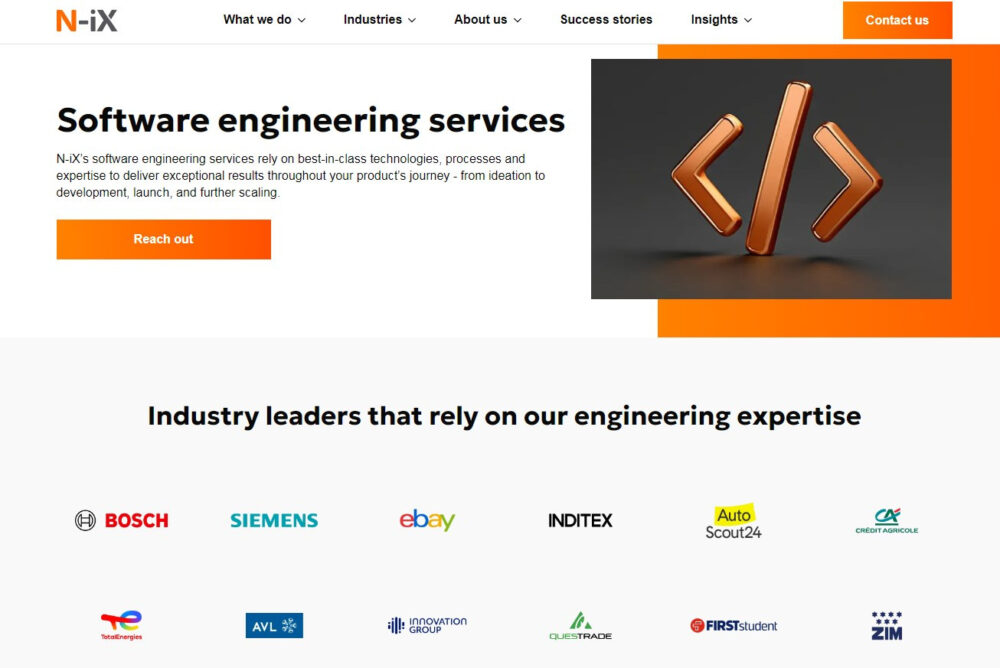
N-iX delivers product engineering services that move on-premises SQL servers to cloud platforms while keeping development pipelines running. Their work includes CI/CD modernization that prevents system downtime during transition.
Zero Downtime Product Engineering Track Record
A global stock photography platform needed to move from on-premises SQL servers to the cloud. The platform handled millions of media assets. Stopping data processing was not an option.
N-iX executed a product engineering migration of data to cloud-based DBT and Snowflake. The team also moved SSRS reports from on-premises servers to Looker, a Google Cloud analytics platform. They created, upgraded, and optimized over 70 new reports for financial, sales, and marketing departments.
The team migrated the CI/CD pipeline from Jenkins to GitHub Actions. This improved data quality was deployed into production and prevented system downtime during the software release cycle.
Standalone features for zero-downtime product engineering:
- SQL server to Snowflake migration with continuous processing
- SSRS to Looker migration without report interruption
- Jenkins to GitHub Actions with zero pipeline downtime
- 70 plus reports optimized during live migration
Primary strength: SQL database and CI/CD pipeline migration with continuous data processing.
4. SoftServe
SoftServe uses agentic AI within their product engineering services to modernize legacy codebases while reducing manual effort. Their AI agents analyze, refactor, and migrate code without stopping development.
Zero Downtime Product Engineering Track Record
A seismic modeling enterprise needed to migrate 82 C++ modules from on-premises to the cloud. Traditional manual migration would have required five days of development and three days of testing per module. The total time would have stretched months.
SoftServe deployed an AI agent specialized in modernization as part of their product engineering engagement. The team automated C++ module refactoring, shared memory implementation between Julia and C++, and Makefile modifications. Manual coding efforts dropped 50 percent. The migration finished faster with minimal human intervention and uncompromised accuracy. Development never stopped during the process.
Standalone features for zero-downtime product engineering:
- AI agents that analyze codebases and dependencies automatically
- Automated refactoring that preserves business logic
- Pilot testing on small modules before full migration
- Post migration support to ensure stability
Primary strength: C++, COBOL, and legacy codebase migration using AI agents.
Comparison Table: Zero Downtime Product Engineering Capabilities
The four firms below have executed these strategies for enterprises that cannot afford a single second of interruption. Here is how their zero-downtime capabilities compare.
| Company | Primary Migration Target | Zero Downtime Method | Business Result |
| Avenga | Core banking systems | Phased cutover with parallel runs | 13-month migration, zero downtime |
| Intellias | Mainframe and UniVerse | Incremental workload migration | 99.999% availability, 39% revenue growth |
| N-iX | SQL servers and CI/CD | Live data processing during migration | Zero pipeline downtime, 70+ reports migrated |
| SoftServe | C++ and legacy codebases | AI agent automated refactoring | 50% less manual coding effort |
The table above gives a quick snapshot of each firm’s zero-downtime capabilities. The following breakdowns provide the specific proof points that matter most to enterprise procurement teams.
How These Product Engineering Companies Compare on Zero Downtime Migration
Reference calls tell the rest of the story. Here is what each firm actually delivered on zero-downtime projects:
- Avenga runs parallel systems during product engineering migration. Old and new platforms operate simultaneously. Data synchronizes between both. When the new system proves stable, traffic switches in seconds.
- Intellias moves workloads incrementally as part of their product engineering services. Three hundred plus workloads migrated to AWS while the mainframe kept running. Each workload was moved, validated, and switched without touching the others.
- N-iX keeps data processing live during SQL migration within their product engineering engagements. Records flow into both old and new databases. Teams validate cloud data against on-premises sources before cutover.
- SoftServe uses AI agents to analyze and refactor code without stopping development. The agent reads the codebase, identifies dependencies, and rewrites modules while engineers continue their regular work.
Bottom Line
Zero downtime migration separates professional product engineering from amateur work. Any firm can move data with a weekend maintenance window. Few can do it while systems run live.
Avenga provides product engineering services that move core banking platforms with parallel runs and phased cutovers. Intellias delivers product engineering services that migrate mainframe workloads incrementally without touching live operations. N-iX executes product engineering services that keep SQL data processing flowing during cloud migration. SoftServe offers product engineering services that use AI agents to refactor legacy code while development continues.
These four product engineering companies have executed these strategies for enterprises that cannot afford interruptions. Their track records prove zero downtime migration is possible. The question is which firm matches your specific legacy environment.