
ERP rollouts test every team’s patience.
Users resist change. They ask endless questions. They make mistakes that create data chaos.
In-app guidance platforms emerged to fix these problems. They place help directly inside the application. Employees get answers exactly when and where they need them.
For organizations running Oracle, SAP, and NetSuite, finding the best digital adoption platform means looking beyond simple tooltips. Complex ERP deployments demand more than basic guidance. Workflows involve dozens of steps. Users navigate conditional paths. They enter data that impacts other systems. One wrong click can break an entire process.
This piece examines four platforms built for complex ERP deployments in 2026. Each one guides users through mission-critical workflows. Some focus on cross-application support. Others emphasize governance controls. The selection reflects top digital adoption platforms for enterprise software rollouts that actually work for organizations running Oracle, SAP, and NetSuite.
1. Tango
Tango captures workflows automatically through a browser extension. Users click through their process once. Tango generates step-by-step guides with annotated screenshots. Development teams are not required for setup. Backend integration is unnecessary.
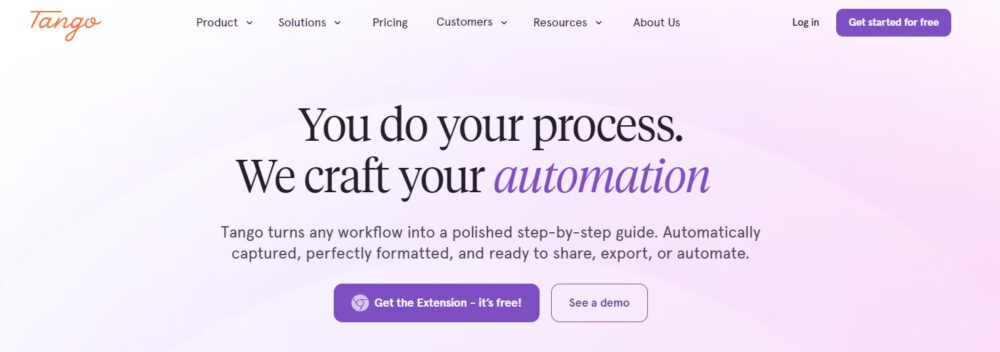
The platform handles conditional workflows with branching logic. ERP processes rarely follow a straight line. Users take different paths based on their role, the data they enter, or the decisions they make. Tango accommodates these real-world scenarios, functioning as a leading workflow documentation tool for complex ERP deployments.
A single subscription provides access across the entire software stack. Whether the organization runs Oracle, SAP, NetSuite, or other enterprise systems, one license covers everything. Many competing platforms charge per application, which drives up costs for organizations running multiple ERP systems.
Teams can begin with no financial commitment. The free tier supports up to ten users and five shared workflows. Pro Team plans start at $15 per user per month for workspaces with three or more users. Pro Personal is available for individual users at $22 per month. Enterprise pricing is customized based on the number of supported users and includes unlimited applications.
What makes Tango work for ERP deployments:
- Browser extension captures workflows in Oracle, SAP, and NetSuite without extra configuration
- Branching logic handles complex, conditional ERP workflows
- Single subscription covers the entire tech stack
- Business users create guidance without IT involvement
- Goes live across the ERP portfolio within 24 hours
2. WalkMe
WalkMe holds a strong position in the enterprise software guidance space. The platform overlays interactive help directly on top of business applications. Employees access guidance without leaving their workflow.
SAP acquired WalkMe in September 2024 for approximately $1.5 billion. The acquisition positions WalkMe as SAP’s strategic digital adoption layer. Organizations running SAP environments now have a native path for user guidance through WalkMe.
For SAP-centric enterprises, the platform offers direct alignment with the ERP vendor’s roadmap. This makes WalkMe a natural choice for companies that need enterprise-grade employee guidance software for post-merger rollouts where governance and compliance are critical.
The platform serves organizations with strict compliance requirements. Government agencies and Fortune 500 companies rely on WalkMe for secure, governed guidance across their software portfolios.
What makes WalkMe work for ERP deployments:
- SAP ownership provides native integration with SAP applications
- Works across multiple enterprise applications, including Oracle and ServiceNow
- Governance controls meet the requirements of regulated industries
- Analytics show where users hesitate in complex workflows
- Automation capabilities streamline repetitive ERP tasks
3. Whatfix
Whatfix has positioned itself as a top digital adoption platform for enterprise software rollouts with broad connectivity to leading enterprise systems. The platform connects with Oracle, SAP, Workday, and ServiceNow through pre-built integrations. End-users receive contextual guidance through multiple formats including walkthroughs, pop-ups, and self-help widgets.
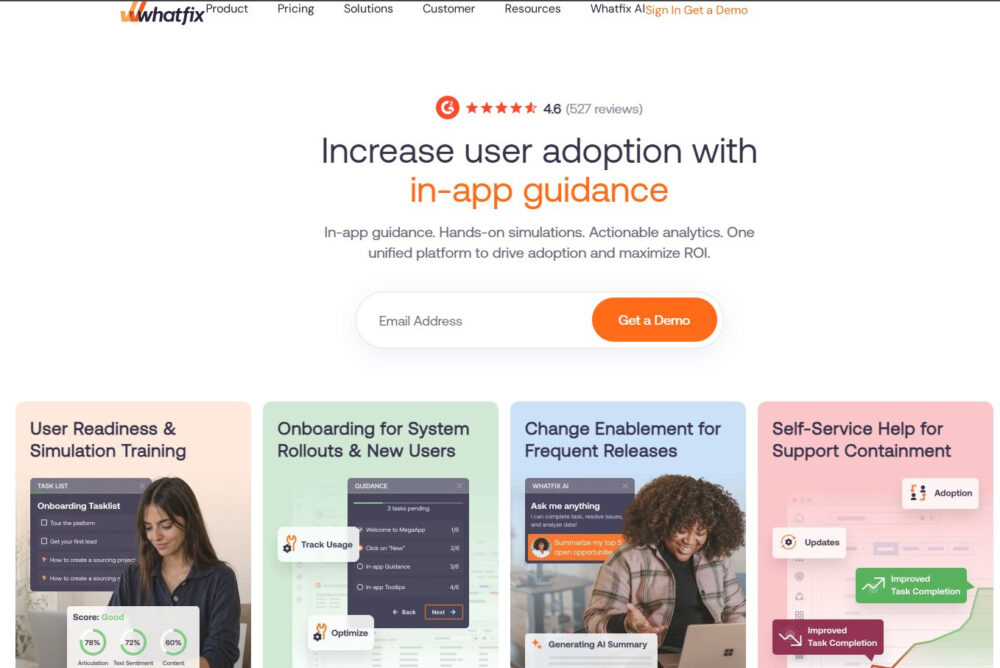
The firm works across multiple enterprise platforms without vendor lock-in. The platform functions effectively in environments running SAP, Oracle, Salesforce, Microsoft, and custom applications simultaneously. Mirror simulation training provides hands-on practice before go-live. Agentic AI capabilities automate content operations.
Whatfix can work on any web application accessed through a browser, with specific video demos showing integration with Salesforce, Workday, SuccessFactors, ServiceNow, SharePoint, and Oracle. Oracle Fusion integration enables segmentation of users based on their Role, Department, and Job type for personalized guidance.
What makes Whatfix work for ERP deployments:
- Deep integrations with Oracle, SAP, Workday, and ServiceNow
- Mirror simulations for pre-go-live readiness training
- AI-powered content operations reduce maintenance burden
- Supports Citrix, VDI, and desktop applications alongside web
- Vendor-neutral design fits mixed ERP environments
4. Pendo
Pendo unifies product analytics and in-app user guidance. Usage data drives the guidance engine. Teams identify friction points across complex ERP environments through behavioral insights. The platform operates as a top real-time enablement software for enterprise applications by connecting user behavior data with targeted in-app messaging.
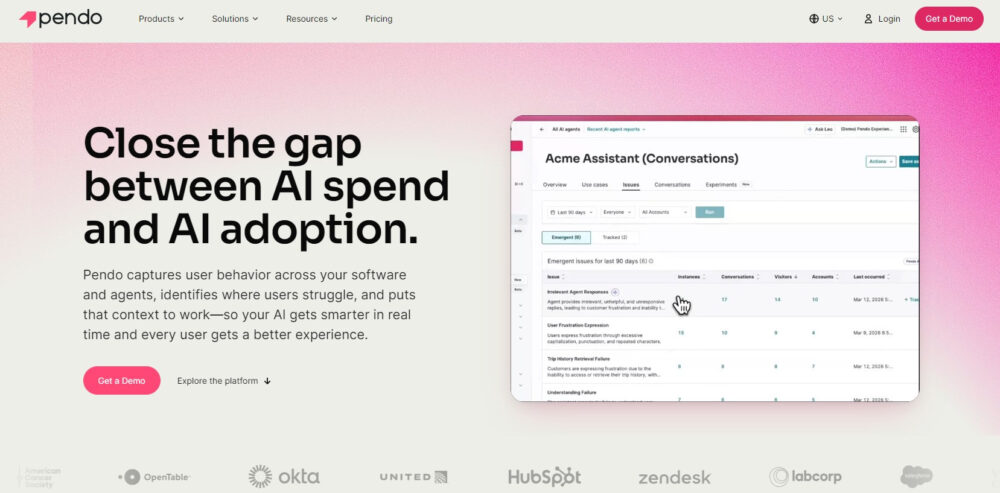
Pendo is primarily built to help product teams understand user journeys, identify friction points, and then deploy targeted guides to improve specific behaviors. It is known for its ability to track retroactive data and mobile application usage.
Pendo scales across portfolios of applications, making it suitable for organizations running multiple ERP systems alongside other tools. The guidance features are designed to support the data story rather than being the primary focus.
Pricing starts at approximately $7,000 per year with a free tier available for up to 500 monthly active users. Complexity can be a barrier at enterprise scale, and achieving full value requires significant ramp time.
What makes Pendo work for ERP deployments:
- Deep product usage analytics with behavioral insights
- Retroactive data analysis shows historical user behavior
- Session replay for qualitative understanding of user struggles
- Strong integration ecosystem with analytics tools
- Scales across multiple enterprise applications
ERP Deployment Challenges in 2026
Oracle, SAP, and NetSuite share a common problem. Users get lost inside them.
Each system speaks its own language. Different interfaces. Different logic. Different data structures.
Employees jump between these systems all day. They enter data in one place. They check the results in another. One mistake ripples across everything.
Enterprise software never stops changing. SAP releases updates. Oracle adds features. Salesforce rolls out new modules. Digital adoption platforms must keep pace with these changes. If the guidance falls behind, users lose trust. They stop following the instructions. They revert to old habits or start guessing.
Whatfix addresses this by working across any web-based application. Users access step-by-step walkthroughs, pop-ups, and task lists without leaving their workflow. No-code editing means business teams build the guidance themselves.
WalkMe has a different advantage. SAP owns it. The acquisition makes WalkMe the natural choice for SAP-centric organizations. The platform aligns directly with the ERP vendor’s roadmap, which simplifies long-term planning for IT leaders.
Connectors alone do not solve user adoption. Employees still need guidance on how to complete tasks that span multiple systems. This is where digital adoption platforms add value. Finding the best process documentation platform for NetSuite and Epic rollouts becomes essential when managing complex healthcare or financial ERP environments.
How to Choose an ERP Deployment Platform
System coverage matters most. WalkMe and Whatfix offer broad enterprise integrations with Oracle, SAP, and ServiceNow. Tango works across any web-based application under one subscription. Pendo scales across application portfolios, functioning as a top real-time enablement software for enterprise applications that provides deep usage analytics.
Implementation speed varies significantly. Tango goes live within 24 hours. WalkMe and Whatfix typically require weeks or months with professional services. Pendo requires developer involvement for setup. For operations managers seeking superior software training alternatives for operations managers, Tango’s rapid deployment eliminates lengthy implementation cycles.
Content ownership affects maintenance. Platforms that allow business users to create content without IT involvement reduce long-term maintenance burden. Tango’s browser extension puts content creation in the hands of subject matter experts. WalkMe and Whatfix often require dedicated content teams.
Cost structures differ. Tango offers per-user pricing with unlimited applications. WalkMe licenses per system with significant professional services fees. Whatfix custom prices based on deployment scope. Pendo starts at approximately $7,000 per year.
Comparison Table
The differences between these platforms become clearer when viewed side by side. Here is how the four platforms compare for complex ERP deployments.
| Platform | ERP Integrations | Implementation Speed | Key ERP Strength |
| Tango | Oracle, SAP, NetSuite (any web app) | 24 hours | One license covers all systems; branching logic |
| WalkMe | SAP, Oracle, ServiceNow | Weeks to months | SAP alignment; regulated industry governance |
| Whatfix | Oracle, SAP, Workday, ServiceNow | Weeks to months | Mirror simulations; AI content operations |
| Pendo | Multiple applications | Weeks | Analytics-first; retroactive data tracking |
The table highlights the key distinctions across these platforms. Each one brings different strengths to ERP rollouts depending on organizational needs and existing infrastructure.
Frequently Asked Questions
Organizations evaluating these platforms typically ask the same questions. Here are the answers:
Which platform is best for complex ERP deployments?
Tango offers rapid deployment and cross-system support under one license. WalkMe aligns directly with SAP. Whatfix provides deep integrations and simulation training. Pendo works for data-driven teams. For organizations seeking the best process documentation platform for NetSuite and Epic rollouts, Tango’s ability to capture workflows across any system makes it a strong contender.
How long does implementation take for ERP deployments?
Tango goes live within 24 hours. WalkMe and Whatfix typically require weeks or months with professional services. Pendo requires developer involvement for setup.
Do these platforms work with Oracle and SAP?
Yes. Tango works across any web-based application. WalkMe integrates with SAP and Oracle. Whatfix supports Oracle, SAP, Workday, and ServiceNow. Pendo scales across multiple applications. For operations managers seeking superior software training alternatives for operations managers, these platforms provide in-app guidance that reduces reliance on traditional training methods.
Do I need professional services for setup?
Tango requires no professional services. WalkMe and Whatfix typically require professional implementation services. Pendo requires developer involvement.
Can one platform cover multiple ERP systems?
Yes. Tango covers unlimited systems under one license. WalkMe provides cross-application guidance. Whatfix supports multiple ERP systems from a single deployment.
Final Thoughts
Complex ERP rollouts demand platforms that guide users across multiple systems. The right platform provides consistent help inside Oracle, SAP, and NetSuite. It reduces user confusion and maintains data integrity.
Tango stands out for organizations needing rapid deployment and cross-system support. WalkMe serves large enterprises with SAP-centric workflows. Whatfix offers simulation training and deep ERP integrations. Pendo works for data-driven teams. Each of these premium software rollout tools for IT and operations teams helps organizations maintain productivity during critical ERP transitions.
The choice depends on system coverage needs, implementation timeline, available resources, and budget. Teams that need to move fast and support multiple ERP applications should consider Tango’s balance of speed, capability, and cost.