
Picking an alternative to Snyk takes some real thought. You need to consider your organization’s unique security priorities, day-to-day development workflow, and overall risk appetite.
Snyk earned its popularity through strong developer-focused SCA and container scanning capabilities. But as application security programs evolve, many teams run into familiar limitations—whether it’s shallow runtime context, gaps in CSPM, license compliance headaches, or simply wanting everything in one consolidated platform.
That’s why we’ve put together this evaluation of five noteworthy options: Aikido Security, Black Duck, Oligo Security, Jit, and FOSSA. We compare them across features, deployment approaches, and real-world pros and cons to help you decide what works best for your environment.
What Modern Security Programs Need Today
It is helpful to pause briefly before examining Snyk alternatives. Modern application security programs have evolved considerably in recent years, so it is useful to consider what organizations truly require today.
In the past, many companies assembled a collection of separate point solutions — SAST in one tool, SCA in another, along with CSPM, runtime protection, secrets scanning, and container security. This approach frequently resulted in tool sprawl, excessive alerts, and fragmented visibility that complicated security efforts for both development and security teams.
Today, teams seek more integrated platforms. They want solutions that reduce complexity and focus on genuine risks rather than generating noise.
Important capabilities include:
- Developer-friendly workflows that integrate smoothly into daily processes
- Prioritization based on actual, exploitable risks instead of every potential vulnerability
- Runtime context to distinguish dormant CVEs from those that pose real threats in live environments
- A single, consolidated view across code, cloud, containers, dependencies, and APIs without managing multiple dashboards
At their core, these programs need better consolidation, smarter prioritization, and stronger automation. Each of the Snyk alternatives ahead approaches these needs differently, ranging from comprehensive platforms to tools with a sharper focus on runtime security.
Best Snyk Alternatives for Modern Security Programs
No tool fits every organization. Snyk excels at SCA and container scanning, but modern programs often need broader coverage, runtime context, or deeper compliance. The alternatives below range from all-in-one platforms to runtime-driven engines and enterprise solutions.
Aikido

Aikido is widely regarded as one of the best Snyk alternatives, offering an all-in-one DevSecOps platform that combines application, cloud, and runtime security within a single interface, eliminating the need for teams to manage multiple security products.
By bringing security testing, cloud posture management, dependency analysis, container protection, and runtime monitoring together, Aikido helps development and security teams manage vulnerabilities, compliance requirements, and cloud risks without switching between separate tools.
This platform aims to simplify things without sacrificing depth. It provides solid security across the full development lifecycle, from early stages to production.
Many of its capabilities are included by default, even ones that usually require upgrading plans or buying extra products elsewhere. That’s probably why it’s become a go-to choice for teams who want comprehensive coverage without unpredictable costs.
Notable features cover SAST, DAST, Software Composition Analysis (SCA), Infrastructure as Code scanning, container security, Cloud Security Posture Management (CSPM), secret detection in and out of the IDE, API security, malware scanning, open-source license checks, runtime protection including an in-app firewall, custom local scans, on-prem deployment, and CI/CD integrations designed around how developers actually work.
Pros
- One platform covers the full spectrum of modern application security
- Low-touch operations enable rapid deployment and frictionless scaling
- Developers spend less time triaging alerts and more time fixing real risks
Cons
- Different approach than traditional security tools
- Some onboarding may be needed for legacy-focused teams
- Less focused on highly customized procurement processes
Black Duck

Black Duck is a strong enterprise application security platform that brings together SCA, SAST, DAST, API security testing, container security, and software supply chain protection all in one place.
It really shines at helping organizations uncover vulnerabilities in open-source components, proprietary code, binaries, firmware, AI-generated code, and other third-party dependencies. At the same time, it puts serious focus on supply chain visibility and staying compliant with regulations.
Unlike many tools built mainly for developers, Black Duck emphasizes SBOM management, enterprise governance, and clear policy enforcement. That makes it especially well-suited for companies with strict security standards, compliance demands, or specific data residency needs. You can run it as SaaS, on-premises, or in a hybrid setup.
The feature set is solid. You get SAST, SCA, DAST, and API security. It scans open-source code, proprietary code, binaries, and even AI-generated code. Plus SBOM support, dependency tracking, license compliance, automated policies, container protection, and flexible deployment options.
Pros
- Strong software supply chain visibility and advanced SBOM management
- Extensive governance, policy enforcement, and enterprise reporting capabilities
- Supports regulated industries requiring on-premises deployments
Cons
- Resource-intensive for on-premises deployments
- Setup and integration can be complex, especially in large environments
- User interface and reporting capabilities feel dated compared to newer platforms
Oligo Security

Oligo Security takes a runtime-focused approach to application security. It helps teams figure out which vulnerabilities actually matter in live production environments by watching how applications behave in real time.
Instead of depending only on static scans and dependency lists, Oligo checks whether vulnerable code, libraries, or functions are actually running. This cuts down on alert fatigue and lets security teams focus their efforts on the real threats.
The platform blends runtime observability, exploitability analysis, supply chain security, and vulnerability management for better context than traditional SCA tools. It continuously monitors live activity to show the true impact of issues in both custom and third-party software.
Key features include runtime prioritization, execution analysis, continuous SBOM generation, VEX reporting, supply chain monitoring, and real-time risk visibility.
Pros
- Runtime-driven prioritization reduces false positives and alert fatigue significantly
- Continuous SBOM and real-time impact analysis for newly disclosed vulnerabilities
- Lightweight sensor provides deep function-level monitoring with minimal overhead
Cons
- No automated code repair — engineering teams must still write and push fixes
- Not a complete CSPM — may need pairing with other tools for cloud misconfigurations
- Post-incident workflow limits compared to vendors with heavy ticketing or forensic remediation
Jit
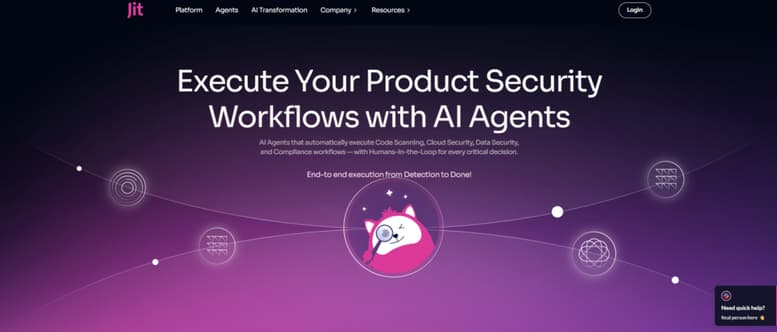
Jit is a DevSecOps platform that integrates runtime, cloud, infrastructure, and application security. Throughout the whole development lifecycle, it helps teams find, rank, and address vulnerabilities.
Instead of focusing only on code scanning or SCA, Jit incorporates a number of security features and uses automation to reduce the workload.
Its developer-first design weaves security into everyday workflows, while security teams get a consolidated view of repos, cloud assets, applications, APIs, and pipelines.
Main features include SAST, SCA, secrets detection, IaC scanning, container/CSPM/DAST security, Kubernetes and serverless protection, AI-powered risk prioritization, automated remediation, and integrations with GitHub and GitLab.
Pros
- Broad security coverage across code, cloud, infrastructure, API, and runtime in one platform
- Automated onboarding and AI-powered workflows reduce operational complexity
- Developer-focused integrations help reduce security-related friction for engineering teams
Cons
- Advanced features may take time for new teams to master
- Pricing may become less predictable as teams scale
- No on-premises or self-hosted deployment option available
FOSSA

FOSSA helps organizations handle open-source risks through software composition analysis and compliance tools.
Unlike many SCA solutions that focus mostly on security vulnerabilities, it puts real weight on license compliance, policies, and governance. That makes it a strong pick for companies serious about tracking their open-source usage and staying on the right side of legal requirements.
It keeps an eye on projects by scanning for components, watching for new vulnerabilities, following dependency shifts, and making sure licenses are in order. Legal, security, and dev teams can collaborate more easily thanks to clear audit trails.
Among its main features, you’ll find vulnerability detection, comprehensive license management, multi-ecosystem dependency tracking, custom policies, automated reporting, CI/CD integration, and fine-grained governance controls.
Pros
- Excellent license compliance management and governance for regulated industries
- Custom policies align with internal legal and security requirements
- Strong audit trails, reporting, and access controls for large-scale compliance programs
Cons
- Limited vulnerability detection — primarily built for license compliance, not code-level security
- UI can feel slow, and scans take longer operationally compared to alternatives
- Harder manual triage — does not always show the exact line of code causing the issue
Conclusion
Switching from Snyk or building on top of it really depends on your organization’s current security maturity and practical limitations.
Aikido gives the widest all-in-one solution for teams tired of juggling multiple tools. Black Duck continues to be a solid choice for regulated industries that require robust SBOM handling and on-prem deployment. Oligo excels at runtime prioritization, especially if false positives are burying your team. Jit brings strong integration into developer workflows with helpful AI automation. And FOSSA is particularly strong when open-source license compliance and governance are top priorities.
Three primary variables should be taken into account when making your decision: how much runtime visibility you require, whether on-premises or hybrid deployment is necessary, and whether code vulnerability detection is more important for your setup than licensing compliance.