
72% of enterprises report failed AI pilots due to weak engineering support. Interestingly, securing a partner who can scale past proof-of-concept is often tougher than getting the budget approved.
The jump from a demo model to production AI in regulated settings is where most companies struggle. It clearly separates basic vendors from real partners. Too many firms focus on one strength while ignoring deployment, team quality, or cross-industry experience.
Businesses need services that balance custom AI development with the operational discipline to keep systems running smoothly under load and compliance demands.
We evaluated providers on five important criteria: scalability, ML expertise, track records, team availability, and custom development ability. The 9 firms listed here offer the best mix of technical skill and real-world delivery.
Leading Engineering Services
Claiming AI expertise is easy. Shipping to production is not. These nine firms earned their spots based on actual deployment and scaling track records. Your choice comes down to technical requirements, team structure, and how much hand-holding you want.
GetDevDone™
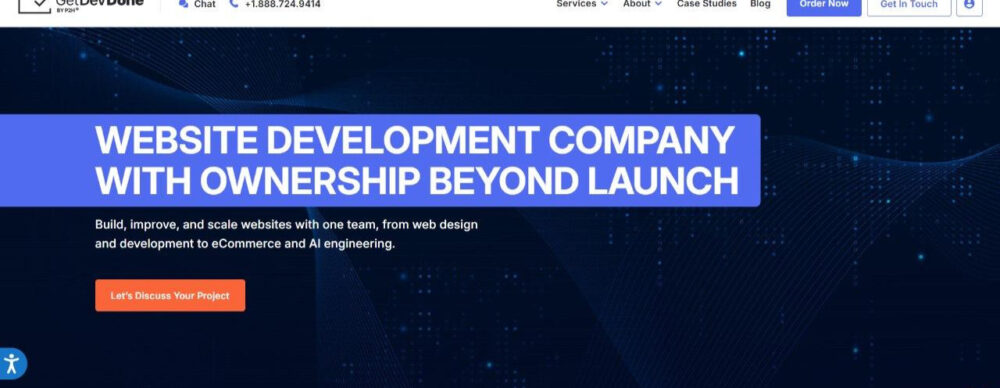
GetDevDone™ is a website development company helping agencies and brands build, improve, and scale websites, from web design to eCommerce and AI engineering in one team. Since 2005, GetDevDone has delivered 131,000 projects for over 15,150 agencies and brands worldwide.
AI engineering services from GetDevDone™ are built for organizations requiring flexible engagement models—whether augmenting existing teams or building dedicated AI engineering squads from scratch. The company’s approach centers on matching technical depth to deployment complexity rather than offering off-the-shelf platforms, making it a practical option for businesses pursuing custom AI initiatives.
The big advantage is their adaptability. They scale the team size depending on where you are in the project, which is really helpful when requirements keep changing between the early stages and full production.
Thanks to their white-label approach, they fit neatly into your existing setup without adding overhead. Being part of the P2H® Group gives them access to over 400 engineers and more than 20 years of delivery know-how.
Their AI engineering services cover prototype-to-production work, embedding AI into websites and eCommerce platforms, and even rescuing messy AI-generated code. On top of that, they also provide website development and digital design services.
Pros:
- Flexible team scaling matches project phases
- AI prototype-to-production expertise
- Direct integration with existing workflows and tooling
- Backed by 400+ engineers and 20+ years of experience
- Experience with clients including Cisco, Maersk, Discovery, NETGEAR, Equinix, Havas, and VML
Cons:
- Limited public AI case studies compared to larger AI-focused vendors
Why Choose GetDevDone™?
GetDevDone™ fits agencies and organizations that need scalable development support without expanding internal teams. Its combination of AI engineering, web development, eCommerce expertise, and white-label delivery makes it particularly well-suited for businesses seeking a long-term technical partner rather than a standalone AI platform provider.
DataRobot
DataRobot offers automated machine learning for enterprises. It takes you from prototype to production without building a full custom stack. The platform handles most of the model-building, testing, and deployment process. This is especially helpful for companies that want to scale AI without growing a huge engineering team.
It works well for business users and data scientists who aren’t full ML engineers. However, very specialized models may still need custom work.
Pros:
- Cuts engineering overhead through automation
- Excellent governance and explainability
- Flexible multi-cloud deployment
Cons:
- Steeper learning curve for some users
- Pricing only available through sales
Why Choose DataRobot?
It’s a solid choice when you need to make AI accessible across the business while maintaining strong oversight. The automation handles the heavy technical lifting, freeing your team to focus on strategy — particularly valuable in sectors like finance, healthcare, and manufacturing.
Turing
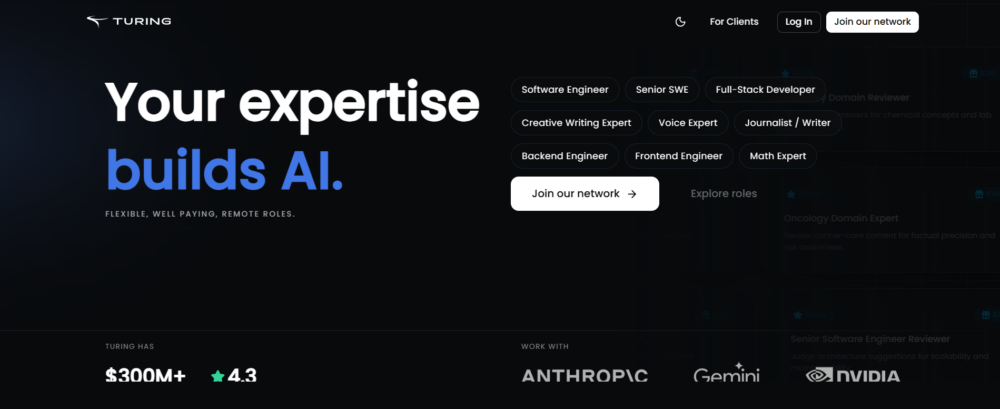
Turing serves as a talent platform that helps enterprises quickly assemble AI engineering teams from a pool of pre-vetted professionals. You gain flexibility to adjust team size as projects evolve, without the delays and costs of regular hiring.
While they emphasize quality vetting, public details on outcomes and case studies are somewhat limited. The service works best for companies that manage remote work comfortably and need specialized skills across different time zones. Pricing is always custom, depending on the engineers and engagement length.
Pros:
- Pre-vetted talent lowers hiring risks
- Easy scaling for changing project demands
- Global reach supports round-the-clock work
Cons:
- No public pricing — custom quotes only
- Limited visible proof of deployment success
Why Choose Turing?
Choose Turing when you need skilled AI engineers quickly without adding full-time staff. It’s a strong fit for companies running several AI projects at once or entering new technical areas where internal expertise is missing. It works best for organizations that already handle remote teams well and want capacity faster than traditional recruiting allows.
Azumo
Azumo specializes in building custom AI models, though they don’t share much about their team size or when they were founded. What really sets them apart is their focus on actually getting AI into production. They don’t stop at creating the model — they handle the full integration with your existing systems.
They manage everything from initial design through to deployment and ongoing monitoring. This full-lifecycle approach is especially useful for companies that need AI embedded into critical operations where smooth handoffs matter.
Many AI providers are great at prototypes but struggle once legacy systems, compliance, and real-world complexity come into play. Azumo seems to have developed solid processes for these challenges.
Pros:
- Custom models built around your specific business needs
- Strong enterprise integration that reduces deployment headaches
- True end-to-end support
Cons:
- No public pricing (expect quote-based)
- Very few client case studies available
Why Choose Azumo?
Go with Azumo when your AI project has to integrate seamlessly with complex enterprise environments. They specialize in building custom models straight into your operational systems.
If you’re struggling to connect new AI capabilities with old infrastructure, compliance requirements, and multiple platforms, their integration expertise can help you move successfully from prototype to production.
Avenga
Avenga positions itself as a provider of distributed AI engineering teams. While they keep some details like exact team size private, their model focuses on assembling specialists who can tackle multi-layered AI systems — from infrastructure to production workflows.
This setup works particularly well for enterprises operating across several continents. Local expertise and timezone overlap help smooth out global deployments. They seem experienced with complex implementations, though you won’t find many detailed public case studies on results or timelines.
Pros:
- Distributed model ideal for multi-region AI projects
- Handles coordination between data scientists, engineers, and DevOps
- Enterprise-level governance for bigger initiatives
Cons:
- Not much transparency around pricing
- Few published case studies
Why Choose Avenga?
Avenga works best for global AI rollouts that need multiple specialized teams across different regions. Think data residency compliance, localized training, or 24/7 operations. Their distributed model avoids bottlenecks that plague single-location teams.
WEZOM
WEZOM focuses on fast iteration for custom AI solutions. They don’t publish much about team size or exact experience, but their agile approach really compresses the usual design-build-deploy timeline.
This speed lets companies test ideas with real users quickly, before sinking money into heavy infrastructure. They’re a good fit for teams with unique data or specific domain needs that off-the-shelf tools can’t handle. Their sprint structure also makes it easy to pivot mid-project when early results don’t match expectations.
Pros:
- Fast prototyping speeds up time-to-market
- Agile sprints allow real feedback and quick adjustments
- Custom work avoids getting locked into one platform
Cons:
- Limited transparency on team credentials and project scale
- No public pricing or clear engagement terms
Why Choose WEZOM?
Pick them when you need to validate ideas fast rather than spend months planning. Their approach works well for companies exploring new AI uses where needs change as people test early versions. Great if you must show quick results to get internal buy-in.
Vention
Vention builds AI systems with solid infrastructure and DevOps practices at the core. They treat models as real production components rather than isolated experiments. This helps when AI needs to handle actual traffic, updates, and compliance checks.
They focus on bridging the gap between data science notebooks and reliable pipelines. Companies dealing with model drift, monitoring issues, or deployment headaches often find them useful. Their expertise covers container orchestration, automated retraining, and better observability for production environments.
Pros:
- DevOps-first method reduces deployment problems
- Strong focus on long-term model operations and maintenance
- Architecture designed for enterprise reliability
Cons:
- Limited public examples with detailed performance data
Why Choose Vention?
Choose them if your main issues come from infrastructure rather than the models themselves. They suit teams that already have Kubernetes, CI/CD processes, and engineering comfort with infrastructure-as-code. Less ideal if you need heavy exploration or brand-new model development.
DevCom
DevCom offers end-to-end AI development, covering everything from the first concept check to full production setup. They don’t rely on off-the-shelf templates — instead, they design custom solutions based on your actual business needs and current tech stack.
You won’t find team size or engineer profiles on their site, but their work with enterprise clients in finance, healthcare, and logistics speaks for itself. These are fields where regulatory compliance and data protection are critical.
They’re particularly good at moving AI ideas from the research stage into stable, production-ready systems that handle real volumes and complexity. Everything is priced on a quote basis with no published rates.
Pros:
- Single-team ownership from start to finish
- Architectures built specifically for your environment
- Track record in regulated industries
Cons:
- Team credentials not publicly detailed
Why Choose DevCom?
They’re a strong match when you need comprehensive ownership rather than coordinating separate vendors. Having one team manage strategy, development, and deployment helps avoid miscommunication and shortens overall timelines for complex enterprise projects.
Spiral Scout
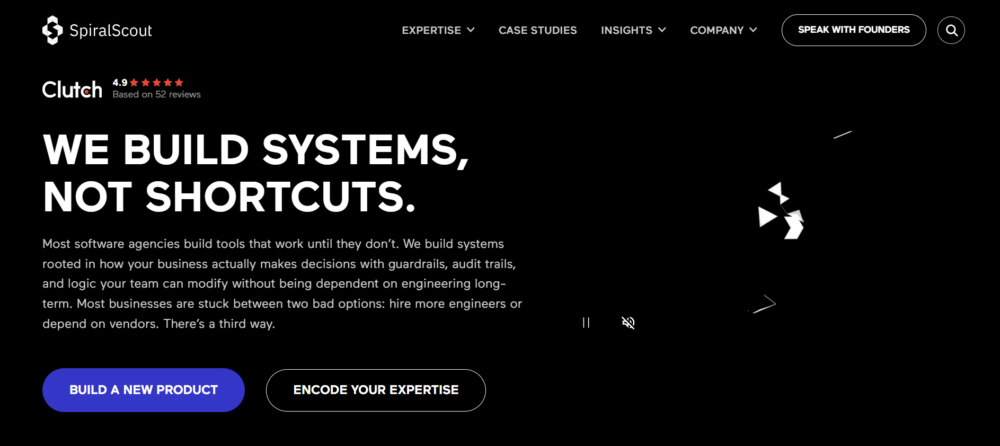
Spiral Scout focuses on AI strategy and hands-on implementation, especially for companies exploring newer applications rather than standard models.
They start with use-case validation before jumping into full development, which helps when working with LLM orchestration, computer vision, or generative AI where best practices aren’t fully established yet.
They combine strategic advice with actual building work. However, they don’t publish many case studies, which makes it harder to evaluate their track record. Their strength lies in early exploration rather than massive, battle-tested deployments.
Pros:
- Thoughtful approach prevents building unviable solutions
- Specialization in emerging technologies
- Consistent support from planning to build
Cons:
- No public case studies or performance metrics
- Limited visibility into team size and capabilities
Why Choose Spiral Scout?
Go with Spiral Scout if your organization is still exploring AI opportunities and wants to minimize risk before full commitment. Their strategy-first style is particularly helpful for generative AI, LLMs, computer vision, and automation initiatives where you need both planning and execution support.
Conclusion
Moving AI from a working prototype to a reliable production system remains the hardest part of any enterprise initiative. The nine providers above each offer a different path across that gap—some through automation platforms, others through custom engineering or flexible talent models. No single firm is the right fit for every organization.
The best choice depends on your internal team’s maturity, your tolerance for vendor opacity, and whether your biggest challenge is infrastructure, talent, or speed. What remains true across all options is this: vague AI expertise is cheap. Proven deployment capability is not. Focus your evaluation on actual production track records, not marketing claims.