
Before committing to any open banking provider, we ran real connection tests across UK banks. Not just reading documentation. Not just checking feature lists. Actual API calls to live bank endpoints.
Here is what we learned.
Bank coverage percentages sound impressive on paper. But coverage means nothing if transaction history stops at 90 days. Or if the categorisation engine mislabels half the transactions. Or if the authentication flow fails for certain building societies.
We tested six providers that claim strong UK bank coverage. Each one delivered different results.
1. Finexer
Finexer is a UK-based open banking infrastructure firm that focuses exclusively on the British market. The company built deep coverage of 99% of UK banking institutions, including high street names and challenger banks like Monzo, Starling, and Revolut.
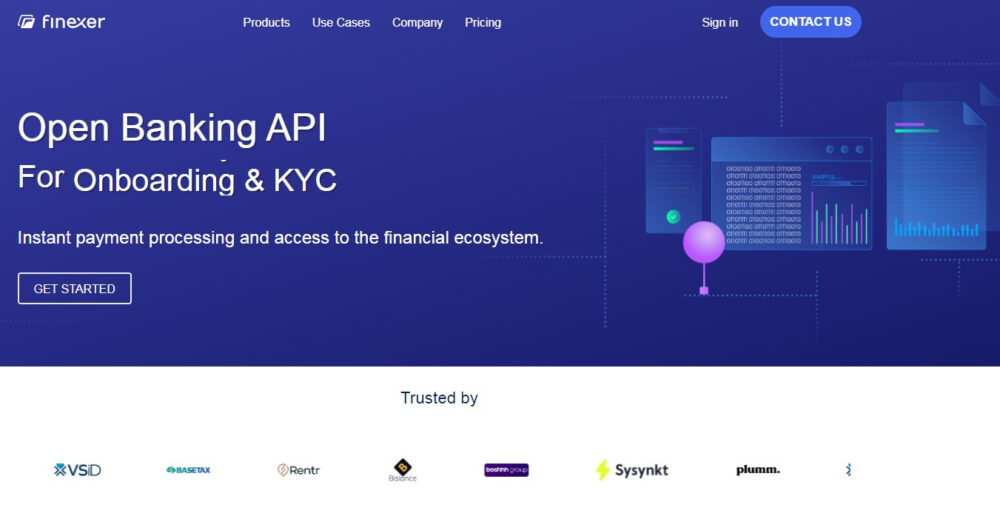
What we tested specifically: transaction history depth, webhook reliability, and consent flow completion rates.
What the tests showed:
- Transaction retrieval reached back seven years per connected account
- Real-time webhooks fired per transaction with no polling delays
- Merchant IDs and category codes arrived already applied – no post-processing needed
- White-label consent flows completed successfully across all major UK banks
This AIS and PIS provider deploys two to three times faster than market alternatives. The company is backed by SFC Capital and the British Business Bank. Finexer recently ranked #32 on Sifted’s 2026 fastest-growing startups list.
Test verdict: The best open banking firm for UK-only coverage we tested. No transaction history gaps. No bank-specific authentication failures.
2. Plaid
Plaid connects to more than 12,000 financial institutions across the US, Canada, the UK, and Europe. This US-based company supports millions of financial interactions daily. For UK coverage specifically, Plaid’s network is strong but not as deep as UK-only providers.
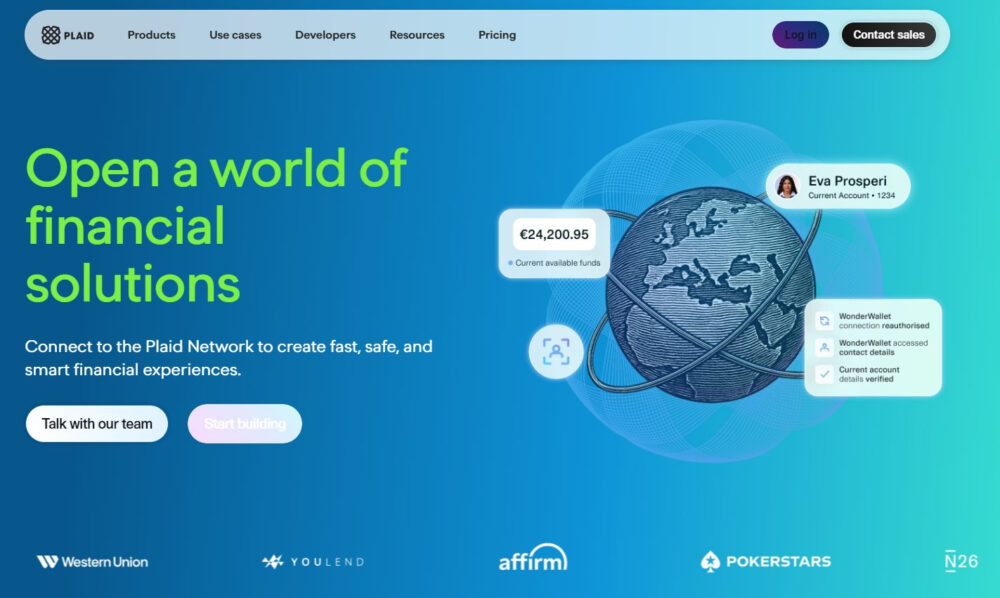
Gr4vy recently partnered with this payment firm to enable Pay by Bank for global merchants through a single integration. That partnership gives merchants access to Plaid’s bank connectivity plus real-time ACH risk insights through Plaid Signal.
What the tests showed:
- UK coverage includes major high street banks but gaps exist with smaller building societies
- Link UX remains the industry standard for consumer-facing connections
- Per-product pricing stacks quickly once you add Identity, Income, and Liabilities
- Transaction data requires more post-processing compared to UK-focused providers
Test verdict: The best provider for platforms needing US and UK coverage from one company. UK-only platforms may find deeper coverage elsewhere.
3. TrueLayer
TrueLayer signed a major partnership with eBay in 2026. The global marketplace introduced Pay by Bank at checkout for UK customers using this open banking firm’s infrastructure.
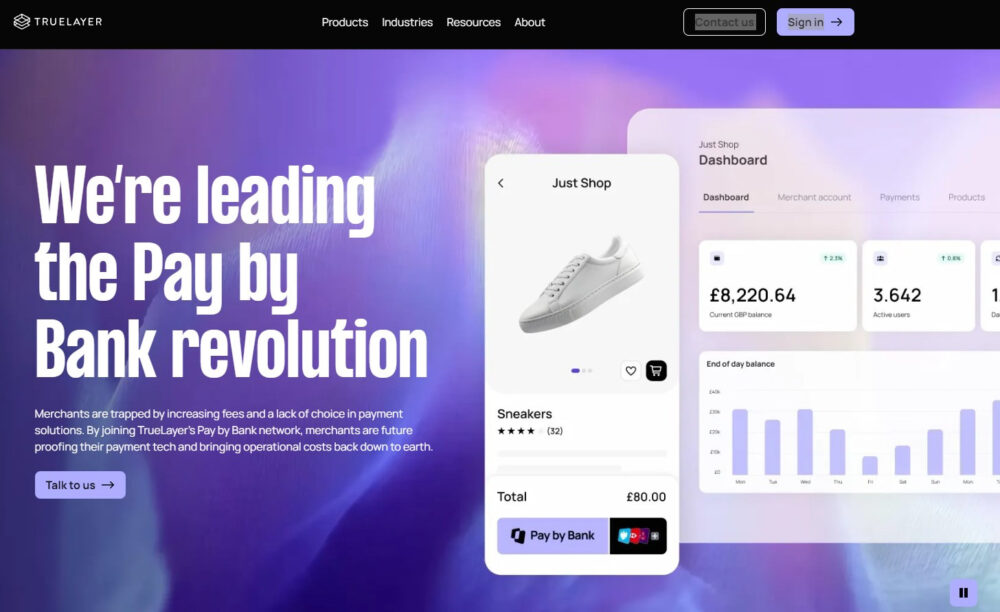
eBay Ventures also made a strategic investment in this payment company, signalling deeper commercial alignment. The integration allows buyers to pay directly from their bank accounts without entering card details. Transactions are authenticated through bank-grade security, with customer login credentials never shared with or stored by eBay.
Francesco Simoneschi, TrueLayer’s CEO, said the partnership embeds Pay by Bank into everyday commerce at scale. Avritti Khandurie Mittal, Vice President of Product for eBay Services, added that Pay by Bank diversifies eBay’s payment mix with a secure, real-time option.
What the tests showed:
- Strong UK coverage with high success rates on major banks
- Payment initiation volume is among the highest in the market
- AIS data returns clean, but payments remain the primary focus
- Some smaller banks returned limited transaction history
Test verdict: The best open banking provider for platforms prioritising Pay by Bank volume. The eBay partnership proves this firm’s enterprise-grade capability.
4. Tink
Visa acquired this open banking firm in 2022 and turned it into Visa’s strategic platform for Europe. The company operates in 18 sovereignties including the UK. More than 3,400 banks and financial institutions connect through Tink’s systems. Over 250 million customers across Europe use services powered by this provider.
More than 10,000 developers use the platform. Every year, this data aggregation company processes over ten billion transactions.
What the tests showed:
- UK coverage exists, but the platform is built for pan-European PSD2 compliance first
- Transaction categorisation uses a structured three-tier hierarchy
- The Link SDK provides unified authentication across different banks and markets
- Enterprise contracts require procurement processes that smaller platforms may find heavy
Test verdict: The best firm for European platforms with UK operations. UK-only platforms may find the enterprise focus too heavy.
5. Yapily
This headless open banking provider powers connectivity for Continia’s UK bank coverage. The integration gives access to Yapily’s Faster Payments capabilities, allowing single and bulk Faster Payments submission and account statement retrieval, depending on what each bank supports.
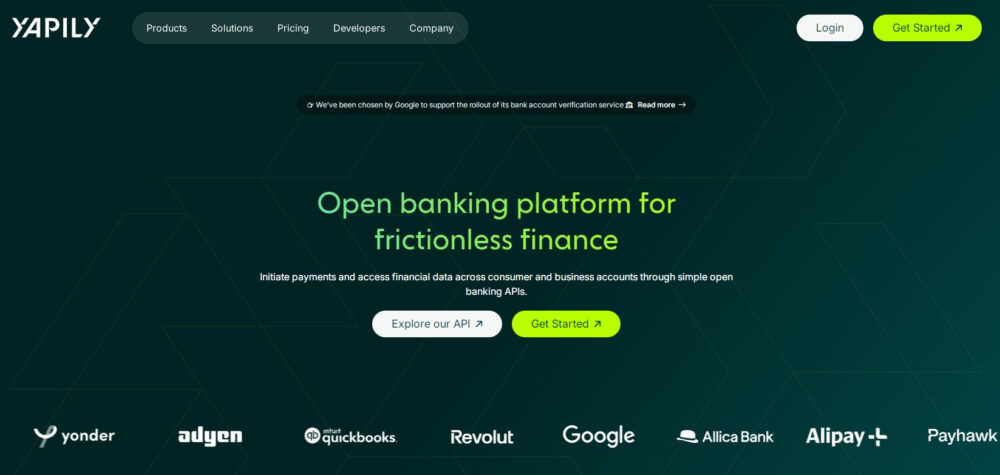
The bank list from this payment initiation firm includes major institutions like Barclays Business, HSBC UK Business, Lloyds, NatWest, Santander, Starling, Monzo, Tide, Revolut, and Wise.
Recent updates from this AIS and PIS company added Airwallex EU for account information services, complementing the existing Airwallex UK integration. Yapily also introduced a new three-tier category structure for transaction data covering both consumer and business accounts.
What the tests showed:
- A headless approach requires building your own authentication screens
- European coverage is strong, but UK depth is comparable to other providers
- New categorisation model adds granularity, but existing clients keep the legacy structure
- Implementation takes longer due to UI development requirements
Test verdict: The best open banking firm for regulated fintechs that need full control over every screen. Not the best provider for teams wanting a quick start.
6. Salt Edge
Salt Edge built its Open Banking Gateway for platforms that want cross-border access. The unified API connects to bank accounts across Europe and other regions.
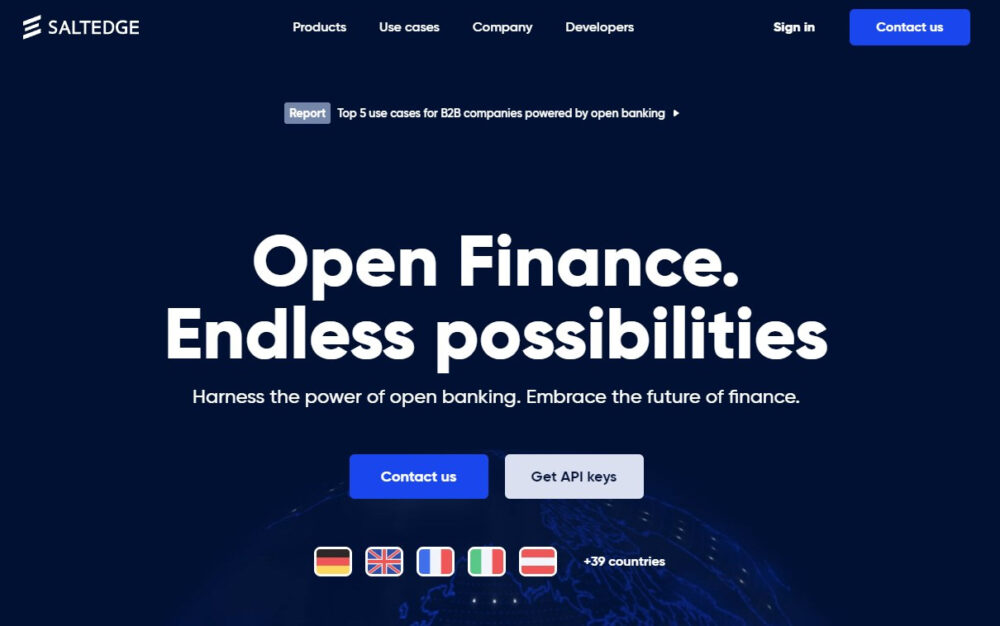
The Partner Programme matters for platforms that do not hold their own open banking licences. This firm allows partners to use the same APIs under Salt Edge’s licence, enabling secure access to PSD2 channels without becoming a regulated TPP.
What the tests showed:
- UK coverage exists, but the platform prioritises cross-border connectivity
- Data enrichment includes transaction categorisation and merchant identification
- Licensing flexibility helps smaller platforms skip regulatory overhead
- UK-only depth is thinner compared to UK-focused providers like Finexer
Test verdict: The best provider for platforms needing multiple European markets without holding their own licence. Not the best firm for UK-only platforms.
How We Ran These Tests
We connected each open banking firm’s sandbox environment first. Then we moved to production endpoints with consent from real account holders across different UK banks.
For each provider, we checked five things:
- Connection success rate. Did the authentication flow complete without errors? We tested across Barclays, HSBC, Lloyds, NatWest, Monzo, and Starling.
- Transaction history depth. How far back could we pull data? Some open banking companies stopped at 90 days. One provider went for seven years.
- Data structure quality. Did merchant names and category codes arrive ready to use or did we need to clean everything ourselves?
- Webhook reliability. Did payment confirmations arrive within seconds, or did we need to poll endpoints?
- Consent flow branding. Could we keep our own brand visible during bank authentication, or did the provider’s name take over?
What the Test Results Taught Us
The gap between coverage claims and actual performance showed up repeatedly. One open banking firm claimed “strong UK coverage” but failed authentication on two building societies. Another provider promised “rich transaction data” but returned unstructured strings that required heavy cleaning.
Here is what we learned that you will not find on pricing pages.
- A ninety-day history is not enough for accounting platforms. Annual reporting needs twelve months of data. Audit trails need even more. Providers offering only 90 days of transaction history cannot serve accounting or ERP use cases.
- Categorisation at source saves weeks of engineering work. Receiving clean merchant IDs and category codes from the API beats building your own classification engine. Finexer, as a UK-based firm, applies these at source. Most other companies do not.
- White-label consent matters more than platforms realise. Every time a customer sees another company’s name during bank authentication, trust shifts away from your platform. The best providers let you keep your brand visible throughout.
- UK-only coverage is not a weakness for UK platforms. European coverage sounds impressive until you realise it comes with higher costs, slower support, and feature gaps on specific UK banks. Deep local coverage from a UK-focused firm beats broad, shallow coverage from a pan-European provider.
Final Thoughts
Open banking infrastructure in the UK has matured significantly. The six open banking firms above all deliver real connectivity to real banks. But “works with UK banks” means different things depending on which provider you ask.
Finexer operates as a UK-based open banking firm focusing exclusively on the British market. This AIS and PIS provider delivers 99% coverage. Seven years of transaction history. Merchant IDs and category codes applied at source. White-label consent flows. Three to five week deployment. The company has backing from SFC Capital and the British Business Bank.
Plaid brings the US-first network with UK expansion. TrueLayer powers enterprise payments, including the eBay partnership. Tink operates under Visa with pan-European PSD2 compliance. Yapily offers headless control for regulated fintechs. Salt Edge provides licensing flexibility for smaller platforms.
Pick the open banking provider that passes the tests that matter for your specific use case. Run the connections yourself. Check the transaction history depth. Verify the categorisation quality. The right infrastructure firm makes your platform faster. The wrong one adds technical debt that takes years to unwind.